Many families in Kota Kinabalu hire their own caregiver for an elderly parent, whether a live-in helper or someone who comes in by the day. The single most important thing you can do to make that arrangement safe is straightforward: do not let your caregiver work alone. A caregiver who is trained, guided and connected to a professional nursing team catches problems early. A caregiver left to manage on their own, however willing and kind, simply cannot.
Why hiring a caregiver is so common in Sabah
Hiring a caregiver to help at home is common right across Malaysia, and especially so in Sabah. It makes sense. A hired caregiver is present around the clock, becomes part of the household, and gives a family real relief. The gap is rarely in the caregiver’s heart. It is in support. Most are taken on without nursing training, given little medical guidance, and then expected to spot the early signs of problems they were never taught to read.
The risk of a caregiver working alone
An untrained caregiver working without backup is a quiet risk. A pressure sore starts small and is easy to miss until it runs deep. A chest infection often shows first as a little more confusion or a little less appetite, not an obvious fever. Medicines get muddled when nobody is checking the list against the prescription. When a caregiver has no one to ask and no clear signal for when to raise the alarm, small problems get found late. Late is where avoidable hospital admissions come from.
How Blue Swan folds your caregiver into the team
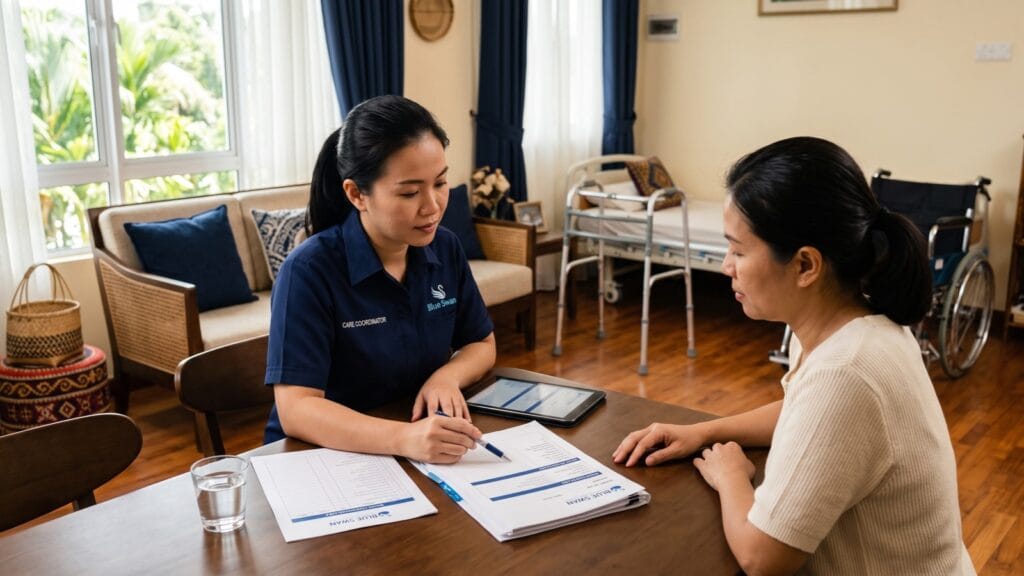
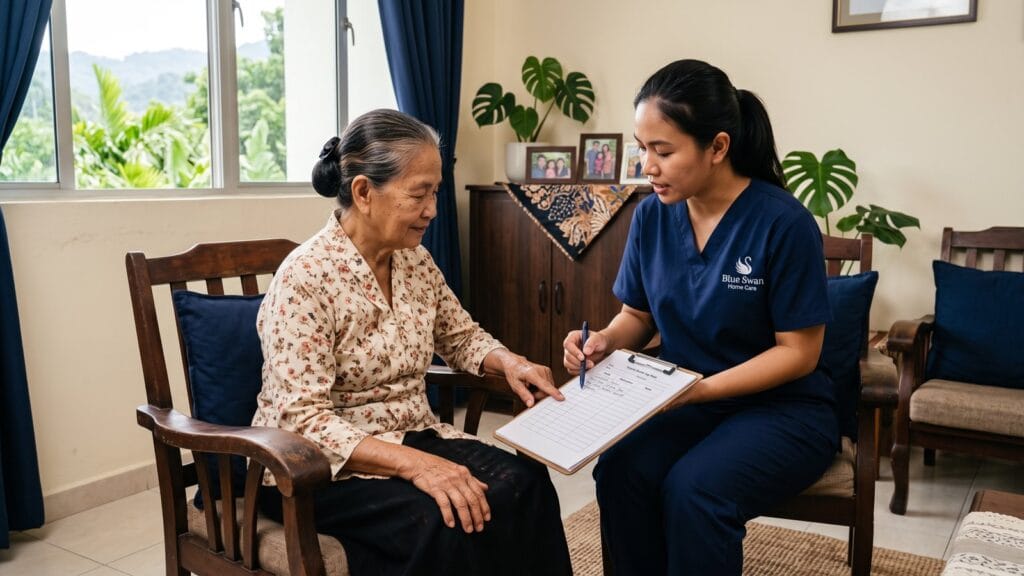
Our model does not replace the caregiver you employ. It supports them. We fold your own caregiver into the Blue Swan care team, so the person at your parent’s side each day is trained, guided and never working blind. In practice that means:
- Training on the things that matter for your parent in particular: safe transfers and positioning, feeding, hygiene, skin care, and how to recognise the early warning signs of trouble.
- A daily reporting loop. The caregiver records simple observations such as blood pressure, oxygen levels and blood sugar and passes them to our nurses, so a worrying trend is seen while it is still small.
- Wound and skin checks by photo, so our nurses can review a wound or a reddening area between visits and step in before it worsens.
- A clear line to escalate. When something looks wrong, the caregiver knows exactly who to contact, and a nurse or doctor can respond quickly.
Training and support that fit your household
Caregiver support in Kota Kinabalu works best when it is built around the parent in front of us rather than a generic checklist. Our nurses show your caregiver the specific tasks your parent’s condition calls for, then keep coaching over time, so their skills grow as needs change. Where there is a wound to manage, this links directly to our nursing and wound care at home, with the caregiver handling the daily routine and our nurses guiding the clinical side.
Part of every plan, not an add-on
This is not an optional extra. Training and supporting a family’s own caregiver is built into every Blue Swan care plan, because it is often what decides whether an arrangement holds together or quietly falls apart. It also connects the caregiver to everything else we coordinate: medicines, equipment, doctor visits and family updates, all through one team and one plan. This integrated way of working is central to how John Cham set Blue Swan up, and you can see how it fits together on our how our care works page. Behind it sits a clinical framework designed by Dr Gordon Pang, geriatrician and State Geriatrician for Sabah; when a case needs a specialist decision, it goes to him or your parent’s own specialist.
Getting the balance right at home
Bringing in a professional team does not push your caregiver aside. It gives the person who is there all day the training and the backing to do the job well, and it gives the family the confidence that someone medical is watching the bigger picture. The caregiver keeps the relationship and the daily rhythm your parent relies on. Our nurses and visiting doctors add the clinical eye. Together, that is a far safer arrangement than either on its own.
Common questions
Can you train a caregiver we have already hired?
Yes. We train and support your existing caregiver, whether live-in or daily, in the specific tasks your parent needs. The aim is to make the arrangement you already have safer, not to replace it.
We want to hire a caregiver in Sabah. Can you help?
We are not a hiring agency, but we work alongside the caregiver you employ and get them ready for the role. If you are still weighing up how to arrange care, a complimentary care planning discussion is a good place to start.
How do your nurses keep track between visits?
Through a simple daily loop. The caregiver records observations such as blood pressure, oxygen and blood sugar and shares them, along with wound photos where relevant, so our nurses can spot a problem early and act on it.
Does this work if I live overseas?
Yes. A trained caregiver plus a reporting loop is exactly what reassures families who cannot be there in person. You get honest updates and know a professional team is keeping watch. Get in touch to talk it through.
If you have hired, or are about to hire, a caregiver for a parent in Kota Kinabalu and want to be sure the arrangement is safe, we can help. Book a complimentary care planning discussion, or read more about our nursing and wound care at home.