A caregiver can cook, clean, and keep your parent company, and that is genuinely valuable. What a caregiver cannot do is catch a dangerous medication clash, reassess a wound, or judge whether sudden confusion is a urinary infection or something more serious. When the signs below appear, an elderly parent in Kota Kinabalu needs medical home care, a home doctor or nurse, not just a caregiver.
Caregiver or home doctor: what is the difference?
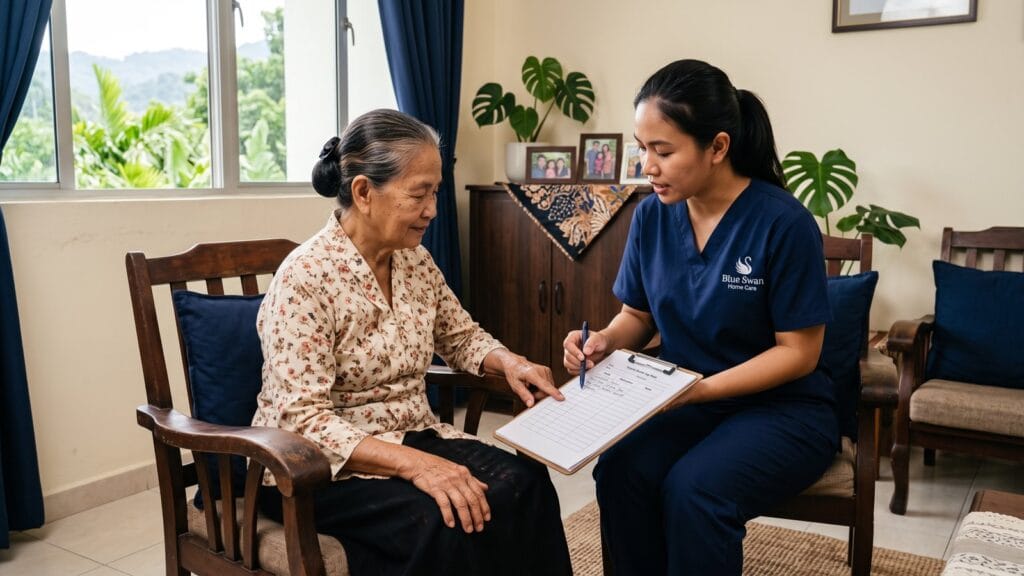
A caregiver supports daily living: meals, bathing, company, and a watchful presence. A home doctor or nurse provides clinical care: assessment, diagnosis, prescriptions, wound and device management, and monitoring, all under medical oversight. Both matter, and the best arrangements often use both. The problem is that families frequently arrange a caregiver when the real need has already become medical. A caregiver is trained to support, not to diagnose, and that boundary is exactly where a quiet problem can slip through until it becomes a crisis.
7 signs your parent needs a home doctor, not just a caregiver
- They take five or more medicines. The more medicines someone is on, the higher the risk of side effects and dangerous interactions. A caregiver cannot safely review or adjust them; a doctor can, and can often simplify the list.
- They keep ending up back in hospital. Repeated admissions or emergency visits usually mean something is going unmanaged at home. That pattern needs a medical eye, not just more supervision.
- They have had a fall, or a few near-misses. A fall in an older person is a medical event, not simple clumsiness. The causes, blood pressure, medication, balance, vision, all need assessing before the next one causes a fracture.
- They are losing weight or barely eating. Unintentional weight loss is one of the clearest signals that something is wrong, from swallowing difficulty to depression to undiagnosed illness.
- There is new confusion or slipping memory. Sudden confusion can be an infection or a medication effect, both treatable. Gradual memory loss needs proper assessment. Neither is something to simply watch.
- There is a wound, catheter, feeding tube, or a condition that needs real nursing. Pressure sores, post-surgical wounds, catheters and tube feeding all sit beyond what a caregiver is trained or permitted to manage.
- You are managing it all from far away. If you live in Kuala Lumpur, Singapore or overseas, a caregiver’s updates are not the same as a clinician’s assessment. You need someone medical laying eyes on your parent and reporting back.
Why the distinction matters
None of this is an argument against caregivers, who do essential work. It is about matching the care to the need. When the need is medical, only clinical care catches problems while they are still small. At Blue Swan, medical and nursing care are coordinated by one team, on a clinical framework designed by Dr Gordon Pang, State Geriatrician for Sabah, rather than left to a caregiver working alone. You can read about our geriatric and frailty care and our doctor home visits.
What to do if you recognise these signs
Spotting one or two of these is not a reason to panic. It is a reason to get a proper assessment rather than quietly adding more hours of caregiving and hoping it holds. The sensible first step is a home assessment that looks at the whole picture at once: the medications, the mobility, the memory and the medical history together, not one complaint at a time.
From there, a clear plan follows. Sometimes that means a medication review to stop something causing more harm than good. Sometimes it is a short course of nursing visits, physiotherapy to rebuild strength after a fall, or a referral the family had not realised was needed. Often it simply confirms that things are stable and well managed, which is its own kind of relief. Either way, the value lies in finding out early, from someone qualified to judge, while a problem is still small enough to solve at home.
Common questions
Isn’t a caregiver enough for an elderly parent?
For daily-living support, often yes. Once there are medicines to manage, wounds to dress, or health that keeps changing, the need has become medical, and that is a different kind of help.
Can Blue Swan provide both medical care and everyday help?
Yes. The model coordinates doctor and nursing care with practical support, so the clinical side is covered rather than left to a caregiver to notice.
What if I am not sure which my parent needs?
That is exactly what the first conversation is for. We listen to what is happening and suggest a sensible next step, with no obligation.
Can you handle dementia or complex conditions?
Yes. Dementia is a particular focus for Dr Gordon Pang, and complex, frail and palliative cases are exactly what the model is built for.
If you are weighing up whether your parent needs more than a caregiver, reach out for a complimentary care planning discussion.